
Paxman Suction Gas Producers
Paxman made gas producers for fuelling their own gas engines and those of other manufacturers. Information on producer gas and suction gas, and the differences between them, can be found on the page Paxman Gas Engines
The upper section of this page is a transcript of the text about suction gas plants found in Paxman Publication No. 650, entitled 'Gas Engines and Suction Gas Producers', dated March 1913. This provides useful descriptions of the construction and operation of Paxman suction gas producers.
The lower section of this page is a transcript of the text of Paxman Publication No. 623, entitled 'Instruction Book for Suction Gas Producers' (undated).
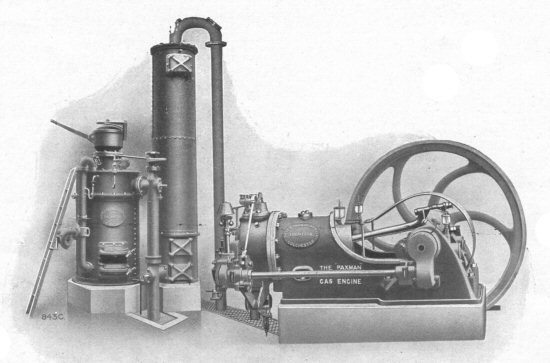
Size K gas engine, complete with suction gas producer.
Special Features of the Paxman Suction Gas Plants :
| No separate steam boiler. No costly boiler setting and flues. No costly chimney. No smoke nuisance. Very little attention required. No risk of fire. Can be shut down and started in a few minutes. No gasometer. Gas generated only as required. |
No danger of explosion. Low fuel consumption. Small floor space required. No skilled labour required. Improved grate for preventing clinker. All parts generously proportioned. Vaporisers readily accessible for inspection and cleaning. |
Paxman Gas Plants.
The Paxman Suction Gas Plant consists essentially of the following three parts: (a) The Generator, where the gas is actually produced. (b) The Vaporiser, which makes the steam for enriching the gas. (c) The Scrubber, in which the gases are cleaned and cooled previous to being used in the engine. The GENERATOR consists of a cylindrical steel shell lined with firebricks ; the latter are supported on a cast-iron dead plate which also carries the firegrate. The fuel, from which the gas is made, is admitted to the combustion chamber by means of a hopper, mounted on top of the generator. Gas is produced by drawing a mixture of air and steam through the incandescent fuel in the generator. The VAPORISER, a vessel into which water is fed, is heated by the gases leaving the generator, and supplies the necessary steam. The air for the plant being caused to pass through the Vaporiser is thus saturated with the requisite amount of steam before entering the generator. After heating the vaporiser, the gases pass into the coke scrubber, where they ascend through a column of coke, kept wet by a suitably arranged sprinkler. The gases then pass along the pipe main, and into the expansion box, which is in direct communication with the engine cylinder.
To start the apparatus, all that is required is to light a fire in the generator, gently blowing this with the hand fan, and in about five to ten minutes' time the gas can be lighted at the trial cock fixed between the scrubber and the engine. When the gas burns steadily, it is satisfactory, and the engine may then be started.
Thenceforward the whole process of gas production is automatic. At each suction stroke, the engine draws a sufficient quantity of gas for its requirements, and when the engine is stopped, the production of gas ceases. There is no gas generated under pressure, consequently there is no fear of explosion, in fact the whole apparatus works under a slight vacuum. Fresh fuel is only required to be fed through the hopper once every few hours, according to the size of the plant, so it will be seen that the amount of attention required is very small.
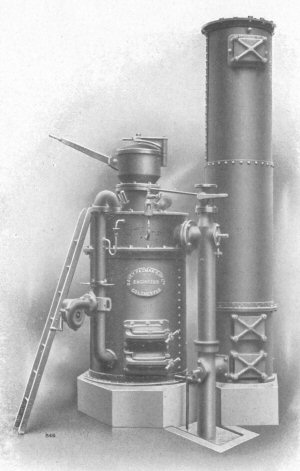 Generator. The generator body is built up of mild steel plates, closely riveted to ensure gas-tight joints. The brick lining is a solid job from the cast-iron dead plate to the top of the generator, and the grate area is so proportioned as to ensure satisfactory working under the loads specified.
Right: Paxman Suction Gas Plant - Sizes A to D.
Vaporiser. The cast-iron vaporiser, which supplies the necessary steam to the plant, is so placed that it is heated by the gases leaving the producer. In this manner, heat is abstracted from the gases, and since they will thus be cooled considerably before entering the coke scrubber, much less cooling water is required in the scrubber than would otherwise be the case. The vaporiser is designed to offer a large heating surface to the gases, whilst at the same time such provision is made for expansion as to reduce to a minimum any tendency for the vaporiser to fracture due to varying temperatures of the producer. When hard water is used in the vaporisers of suction gas producers, it is found that calcareous matters are deposited, which, if not removed, act as very bad conductors of heat ; as a result, the efficiency of the vaporiser is considerably impaired. Having regard to this fact, care has been taken to render the whole of the inside of the vaporiser readily accessible for inspection and cleaning purposes. In the smaller sizes of plants, namely from "A" to "D", the vaporiser is placed at the top of the generator, whilst in the larger sizes, "E" to "H" the vaporiser is arranged between the generator and the coke scrubber.
Firegrate. In the smaller sizes, a simple flat firegrate is provided, whilst in size "E" and upwards a stepped grate of improved design is arranged. With this latter type of grate, clinkering may be conveniently effected whilst the plant is at work.
Fuel Hopper. The fuel feeding hopper is of substantial design, and easy of manipulation ; it is so constructed as to prevent the admission of any air to the generator whilst charging is taking place.
Generator Doors. These doors, which close against machined faces, are of substantial design. There are no loose crossbars or wedges, but a malleable-iron hinge carries the door, which is kept tight by central pressure, and secured by means of a wing nut.
Air and Steam Connections. The air and steam supply to the producer is under absolute control, at the same time there is an absence of plug cocks or valves, which are often a source of considerable trouble, due to the tendency they have of corroding and so becoming difficult to operate.
Inspection Covers, & c. Handhole and cleaning covers are provided on the gas pipes between the generator and the coke scrubber. Poking holes are suitably arranged on top of the producer, so that if occasion arises, the body of the fuel may be poked down in the generator .
Hand Fan. An efficient hand fan, fitted with machine-cut gears, is provided for blowing the fire when starting the plant.
Coke Scrubber. The coke scrubber is of very large dimensions, in order to ensure satisfactory cleaning and cooling of the gases, with a minimum consumption of water. The body of the scrubber is constructed of mild steel plates, riveted together, but the base is of cast iron, so as to obviate the corrosive action which is invariably set up in the bases of scrubbers which are made of mild steel plates throughout. The water sprinkler in the coke scrubber is of an improved type, in which effective distribution of water is obtained without the use of any fine spray holes ; these latter are often a source of trouble due to the tendency which they have of becoming choked by rust or dirt. The scrubber is fitted with substantial cast-iron doors. having machined faces, through which cleaning or charging of the coke scrubber may be effected.
Arrangement of the Plant. For plants of small and medium powers, it often happens that the space available is very limited ; having this point in view, special attention has been given to the design of such plants, in order to render them easily adaptable to confined situations. An adjusting socket has been fitted in the gas pipe between the generator and the scrubber, with which arrangement it is an easy matter to vary considerably the relative positions of the generator and the coke scrubber.
Fuel. The standard type of producer plant illustrated is suitable for using either Welsh or Scotch anthracite, poor coal ("charbon maigre"), gas coke, charcoal, and certain kinds of foreign coal ; but when fuel is used which is inferior to anthracite, it is advisable to have additional cleaning apparatus for the gas. For instance, when it is required to run on coke or charcoal, a static tar extractor should be fixed between the scrubber and expansion box ; and in the case of certain foreign coals, an additional sawdust scrubber should be installed, in which the gas is further cleaned before reaching the engine. When inferior fuel is used in the producer, the power developed by the engine is reduced accordingly. We have plants installed in South Africa, driving stamps, which are running in some cases for a month, night and day, without any stoppage, using nothing but charcoal or the native coal procurable there.
It is of great importance, especially with enquiries from abroad, that clients should give us the fullest possible information regarding the fuel available, and the number of hours the plant will be required to work without shutting down.
The Consumption of anthracite coal with the Paxman plant and engine, working at full load, is less than 1 lb. per b.h.p. per hour ; and taking fuel at £1 per ton, the cost is less than one-tenth of a penny per b.h.p.-hour. Numerous tests taken at our works show a consumption of less than 0.8 lb. per b.h.p. per hour. In the case of coke or charcoal, the consumption of fuel is slightly increased and ranges from 0.9 lb. to 1.2 lb. per b.h.p. per hour, according to the quality. The quantity burnt during a stand-by is very small, amounting in the case of a 20 b.h.p. plant to about ½ lb. of anthracite per hour.
Paxman Gas Plants for Special Fuels.
At the present time we have producers working very successfully both at home and abroad with fuels of such varieties as wood refuse, tan bark refuse, cocoanut shells, chips, shavings, &c. Whilst these plants provide power without incurring any fuel costs, they afford at the same time a suitable means of destroying refuse, which in many trades so often proves an encumbrance. In the case of a plant for wood refuse, it is possible to obtain one brake-horse-power-hour for a consumption of 2½ to 3½ lbs. of fuel, depending upon the percentage of moisture present.
The main principles underlying the design of this plant are much the same as in the case of suction gas plants operating with anthracite as fuel. There are, however, the following principal points of difference: (1) No vaporiser or steam boiler is required ; the necessary steam for enriching the gas, and at the same time keeping down the temperature of the producer, is derived from the moisture contained in the fuel itself. (2) A centrifugal washer is provided for the purpose of removing from the gases all tarry matters and impurities, which, if allowed to pass to the engine, would prevent its working satisfactorily.
Briefly stated, the action of the producer is as follows: On the suction stroke of the gas engine, a slight vacuum is created throughout the gas plant and in the pipes which connect the same with the engine. Air is then drawn through the fan slide into the generator, below the firegrate. As the air passes through the hot body of fuel, such chemical reactions take place that a combustible gas is produced. The gas so generated passes from the upper part of the producer into the dust collector box, thence to the base of the coke scrubber. It now passes upwards through a body of coke kept saturated with water, and afterwards enters the centrifugal washer, where it is freed from all tarry matters. Leaving the washer, the gas is drawn through a sawdust scrubber, where it is dried previous to passing along the gas pipes to the engine.
The starting up of the producer is quite a simple matter, and the attention required is little more than that demanded by an anthracite plant. Owing to the special design of the generator, a uniform draught is created throughout the entire body of fuel, and successful gasification is maintained without any necessity for the constant poking down of the fuel, which is essential to the working of some types of wood refuse producers. As there is practically no clinker formed in the generator, it will be seen that renewals of firebrick lining and firebars will only be necessary after considerably longer periods of running than would be possible with plants operating on anthracite.
It is found that with plants working on wood refuse, there is a great tendency for the pipes between the generator and the coke scrubber to become choked with tarry matters and sawdust drawn over from the producer. In the "Paxman" producer, special attention has been paid to this point, with the result that the above-mentioned trouble has been entirely eliminated. The dust collector box, placed between the generator and scrubber, is so arranged that the gases in passing through it are brought into intimate contact with jets of water which serve the dual purpose of cleaning and cooling the gas, and of keeping the gas passages free from all deposit. Any sawdust which may be drawn over is washed down the gas-pipe into the seal pit, whence it can be readily removed without in any way interfering with the working of the plant. The coke scrubber, fitted with cast-iron base, is of the same generous proportions as in our new design anthracite plants, and the same improved type of sprayer is fitted. The sawdust scrubber is also of ample size, to ensure that there will be no undue suction on the engine. The chimney pipe is fitted direct to the top of the producer, thus avoiding any bends or pockets for the accumulation of tarry deposits, at the same time there is no troublesome cock or valve in this pipe. The chimney is closed by means of an air-tight cover on top of the pipe, and is operated by means of a spindle and lever. Poking-holes are arranged in suitable positions round the generator body, and at various points in the gas connections.
The above type of plant may be adapted to use anthracite or coke, should this at any time become necessary due to a shortage in the supply of wood refuse.
Publication No 623
Instruction Book
for
Suction Gas Producers
Instructions
Paxman Suction Gas Plants.
Description of the Plant. The Paxman Suction Gas Plant consists essentially of the following three parts : —
(a) The Generator, where the gas is actually produced.
(b) The Vaporiser, which makes the steam for enriching the gas.
(c) The Scrubber, in which the gases are cleaned and cooled previous to being used in the engine.
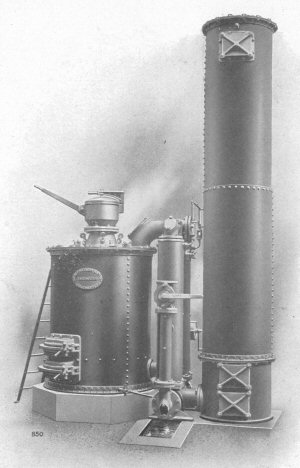 Generator. The Generator consists of a cylindrical steel shell lined with firebricks. The latter are supported on a cast-iron dead plate which also carries the firegrate. The fuel, from which the gas is made, is admitted to the combustion chamber by means of a hopper, mounted on top of the generator. Gas is produced by drawing a mixture of air and steam through the incandescent fuel in the generator.
Right: Paxman Suction Gas Plant - Sizes E to H.
Vaporiser. As will be seen upon referring to the illustrations, the vaporiser of the plants from "A" to "D" sizes inclusive, is mounted on top of the generator casing, but in the "E" to "H" sizes inclusive, it is arranged between the generator and the scrubber. In both cases, steam is generated in the vaporisers, by means of the heat which is given up from the gases, as they pass out of the generator. The air for the plant is also drawn through the vaporiser, and is thus saturated with the requisite amount of steam before entering the generator.
Scrubber. After leaving the vaporiser, the gases pass into the coke scrubber, where they ascend through a column of coke, which is kept wet by means of a suitably arranged sprinkler. The gases now pass along the pipe main, and into the expansion box, which is in direct communication with the engine cylinder.
Foundations. We supply a fully dimensioned drawing, showing the foundations necessary for the plant, free of charge. The producer should be arranged in an open shed or well ventilated building, and the floor round about the plant should be of concrete or stone, in order to prevent any danger from fire, when cleaning out the generator.
Erection. Care should be taken that both the generator and the coke scrubber stand quite vertically on the foundations, and, before coupling up, all pipes and passages must be quite free from obstruction. In many cases where trouble has been experienced in starting the engine, it has been finally discovered to be due to the gas pipes being choked up with cotton waste or similar material. Special attention must be paid to all joints about the producer plant and in the gas pipe which connects the same with the engine, in order to ensure that they are absolutely tight. After the plant is coupled to the engine, the following method is suggested for testing the joints : — Close the gas cock on the engine, and the chimney cock on the plant ; open the test cock near the engine, and shut off the air and steam supply pipe to the generator. Cover the generator grate with paper or shavings, and, after lighting the same and closing the fire-doors, blow steadily with the hand fan. Any leaky joints can then be readily detected by the smoke issuing therefrom.
In order to carry away the effluent from the plant, a pipe must be connected to the seal pit or sump and led into a drain.
Water for the Plant. Water is required both for the scrubber and the vaporiser of the plant. The total quantity required is about 1½ galls. per b.h.p. per hour, so that with a 20 b.h.p. plant, the quantity of water consumed would be about 30 galls. per hour. If the water supply is taken from a tank, the latter should be at least four feet above the top of the scrubber.
Filling of the Coke Scrubber. The coke used for filling the scrubber should be hard, and free from dust. Large pieces should first be laid on the grid at the bottom of the scrubber, then pieces of about ¾" to 1" cubic measurement should be fed in up to the level of the top door. After the scrubber is filled it is advisable to have the water supply to the sprinkler turner on full for a few minutes. The bottom door of the scrubber should then be taken off and any small pieces of coke which may have been washed down through the grids can be removed.
Fuel. The most suitable fuel for the plant is anthracite of good quality but good hard gas coke may also be used, provided that it is fairly free from tar and volatile matters. Whichever fuel is employed should be in pieces of from 5/8" to 1" cubic measurement in order to obtain the best results, and must be well washed and screened if necessary, so that it may be as free from dust as possible. It must be in a perfectly dry state when used. Charcoal may also be employed, but it must be well carbonised, and as free from dust as possible.
When plants are supplied to work on coke or charcoal, a special device is included, without extra charge, for removing any traces of tar that may be carried over with the gas. Ordinary bituminous coal must not be used in the producer.
Preparations previous to Starting. When the plant is first erected, and also after a standby of considerable duration, it is advisable to put a small fire in the generator, and to leave the same burning for a period of about 12 hours ; this procedure will dry the lining and prevent cracking of the firebricks.
The seal pit or sump between the generator and the coke scrubber must be filled with water up to the level of the overflow pipe.
Starting the Plant after Erection or long Standby. Open the firedoor on the generator, and cover the grate with wood shavings and chips. Open the chimney cock. Light the fire in the generator, and after seeing that the fan slide is open, and that the slide on the air and steam pipe is closed, commence to blow steadily with the fan. As soon as the fire is well spread over the surface of the grate, close the firedoor and commence to feed on fuel through the hopper on top of the generator. Feed in sufficient fuel to half fill the generator, before attempting to start the engine. After blowing vigorously on the fan for about five to ten minutes, turn on the water supply to the vaporiser, and allow it to flow in a steady, thin, continuous stream ; also turn on the water supply to the coke scrubber. Continue blowing with the hand fan till the gas at the test cock on the producer will burn with a steady flame. Partly close the chimney cock, and open the trial cock on the gas pipe near the engine. When the gas burns steadily at the trial cock, the engine may be started in the manner described in the Gas Engine Instruction Book. Immediately the engine has started, close the chimney cock on the plant, shut off the fan slide, and open the slide on the air and steam pipe. After the engine has been running for a few minutes, the generator may be filled with fuel up to the level of the underside of the feeding hopper valve.
CAUTION. — Do not stop the fan whilst the gas is being tested at the trial cocks, or the flame may penetrate through to the scrubber, and thus cause an explosion.
Starting the Plant after a short Standby. See that the generator is at least half-filled with fuel ; then commence to blow with the fan, and follow the instructions given above. Sometimes after a standby, if the fire should have become very dull, it will be found that gas can be obtained much more quickly by withdrawing the greater portion of the fuel from the generator, and feeding on a fresh supply ; after the engine has been started, the fuel so withdrawn may be mixed with fresh fuel and fed into the plant.
Running Instructions. Feed fuel into the generator as required. The quantity of fuel used by the generator will vary according to the load which is being carried by the engine. Experience with each particular plant will soon determine at what intervals fuel is to be fed into the hopper. On no account must the hopper valve and the cover be open at the same time. When the plant is at work, see that the vaporiser is kept well supplied with water. In the case of producers fitted with a vaporiser on top of the generator body, the water supply valve should be so adjusted that there is at all times a small quantity of water trickling from the vaporiser overflow pipe into the funnel below. The larger size producers which have the vaporisers external to the generator body, should always have a small quantity of water trickling down the drain pipe which is placed at the base of the generator and leads into the seal pit. The quantity of water passing through this drain pipe may be readily ascertained by opening the trial cock attached thereto. About once every three or four hours the fuel in the generator must be poked down, through the plug holes arranged round the feeding hopper, with the object of consolidating the fuel. The grate bars should also be cleared from time to time ; for this purpose the ashdoor at the bottom of the generator should be opened, and the special poker provided must be drawn through the firebars. This operation should be performed as quickly as possible, otherwise if the door is left open for any length of time, air unmixed with steam will enter the generator, with the result that the gas will be impoverished.
Regulation of Steam. Generally speaking, it will be found that the correct proportions of air and steam are supplied to the plant when the fan slide is closed and the air and steam slide is full open. When it is desired to reduce the quantity of steam passing to the generator, it is only necessary to partly close the slide on the air and steam pipe, and at the same time partly open the fan slide. The best working positions will easily be found for the particular fuel which is being used.
Clinkering the Fire. When a plant is working only about ten hours per day, it will seldom be found necessary to remove any clinker from the fire whilst the engine is at work. It is to be noted that clinker is more readily removable whilst it is hot, and for this reason it is better to perform this operation as soon as possible after stopping the engine. When the plant is working for any lengthy period, it may be found necessary to clinker the fire whilst the engine is running ; the best time for doing so is immediately after filling up the producer with fuel. Turn on the water supply to the vaporiser until there is a liberal quantity flowing into the ashpit, then open one of the firedoors, and carefully remove, by means of the tools provided, any clinker that may have formed. In the case of producers with more than one firedoor, take care not to have both doors open at the same time, and if there is much clinker to be removed, it will be advantageous not to attempt the removal of the whole of the clinker at one operation, but to remove a portion of the same, then closing up the generator for a few minutes before attempting any further clinkering. Do not leave the firedoor open any longer than is absolutely necessary.
It is most important. that the seal pit between the generator and the scrubber be kept free from any accumulation of dust, etc. The gas pipe which connects the generator to the scrubber must be cleaned out from time to time.
It is essential that sufficient water be fed to the coke scrubber at all times to keep the same cool. An average allowance of water to the scrubber is about 1½ gallons per b.h.p. per hour.
Stopping the Plant. After closing the gas cock on the engine, open wide the chimney cock on the producer, and shut off the water supply to the scrubber and vaporisers. Close the slide on the air and steam pipe, and open the fan slide, thus allowing sufficient air to enter the ashpit to keep the fire alight during standby.
Caution. As producer gas is poisonous and has little or no smell, it is advisable to have all doors and windows open when the plant is being cleaned, and one man should not be left alone to do the work. At such times as it is required to re-line the generator or to renew the coke in the scrubber, it is advisable, previous to opening up the plant, to drive all the gas out of the apparatus, by means of the hand fan, after removing the cleaning cover on gas outlet bend. Do not bring a naked light near to the plant whilst any covers are removed, as, should gas be present, an explosion may result.
Upkeep and Cleaning of the Apparatus. The generator should be cleaned out thoroughly at least once every week. The coke scrubber should not require re-charging oftener than once in about nine months, provided that a sufficient quantity of water has been used to keep it cool when working, in accordance with the instructions given above. The bottom of the coke scrubber will need to be cleaned out occasionally ; for this purpose the door at the base of the scrubber will have to be removed.
The gas expansion box, situated near the engine, collects any moisture which may have remained in the gas, and must be drained from day to day.
With plants working on coke or charcoal, a tar extractor is supplied, which will require to be cleaned out at least once every week. The tar, which has become deposited on the plates, may be either burnt off or removed by means of a scraper.
About once in twelve months, the gas piping which connects the producer to the engine should be examined, and any deposit must be removed through the cleaning doors provided for the purpose, at the various bends in the pipe main.
Re-lining the Generator. When the lining of the generator requires to be renewed, great care should be taken to ensure a thoroughly sound job. The firebricks must be quite dry and the joints between same made with fireclay, these joints being kept as thin as possible. The space between the brickwork and the shell of the generator must be filled in with fine dry sand, well rammed down from time to time as the brickwork is built up.
Removing Scale from Vaporiser. The covers on the vaporisers will have to be removed from time to time, and any deposit which may be found must be scraped off ; otherwise the efficiency of the vaporisers will be diminished. About once in twelve months should suffice for the above cleaning, but the amount of deposit formed will vary according to the quality of the water which is used in the vaporisers.
Fuel Storage. It is important that all fuel used in the generator should be quite dry, and for this reason the stock of fuel should be stored under cover, and so placed that it cannot be reached by any water from surface drainage.
DAVEY, PAXMAN & CO., LIMITED.
Page updated: 18 NOV 2014